
Summer 2026 Webinar
DEVELOPING TARGET VERTICAL RESPONSE SPECTRA AND TIME-HISTORY SELECTION AND MODIFICATION FOR THE VERTICAL COMPONENT
Wednesday, 8.5.2026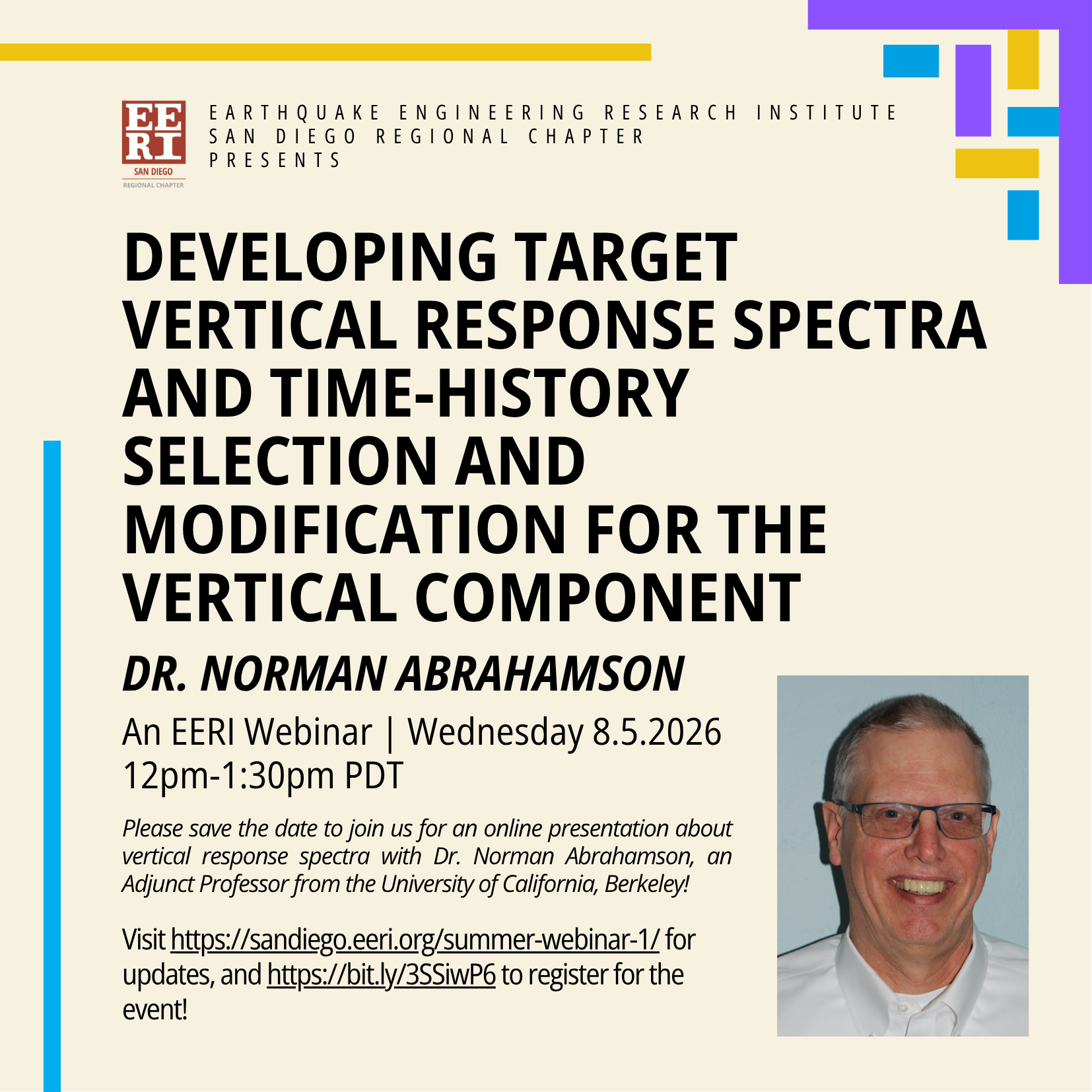
12pm-1:30pm PDT
Virtual Event
Join us for this free webinar presented by Dr. Norman Abrahamson to learn about vertical response spectra. Click the image on the right to view the event announcement.
Abstract
For engineering projects that require both horizontal and vertical components, it has been common practice to develop a vertical spectrum by scaling the horizontal design spectrum that by the median V/H ratio for the controlling scenario. This approach two two key limitations: (1) the relation between the ln(V(T)) and ln(H(T)) is assumed to be linear with a slope of 1.0 and (2) the correlation of the variability of the ln(V(T)) and ln(H(T)) is ignored. There is a large negative correlation. As a result, common practice using the median V/H overestimates the vertical spectrum that goes with the horizontal spectrum for a given return period, but this does not mean that the current approach is conservative because we need to also consider the case in which we start with the vertical spectrum for a given return period and find the horizontal spectrum conditioned on the vertical spectrum (analogous to developing conditional mean spectra for two conditioning periods). An alternative approach is proposed that uses the conditional ground-motion model approach which allows the slope between the ln(V(T)) and ln(H(T)) to differ from unity and greatly reduces the correlation. Using this approach, more realistic pairs of horizontal and vertical spectra can be developed for both the vertical spectrum conditioned on a horizontal spectrum and the horizontal spectrum conditioned on a vertical design spectrum.
A second topic is the scaling and modification of time histories for the vertical component. Because the vertical and horizontal components of the ground motions scaling differently with magnitude, distance, and site condition, the scale factors for the vertical component should be determined independent of the scale factor for the horizontal component and not be fixed to be the same as the scale factors for the horizontal component. The target variability of the vertical spectral values conditioned on the horizontal design spectrum is estimated from the correlation of the vertical and horizontal spectral values and the standard deviation of the vertical spectrum for the controlling scenario.
REGISTRATION
Click here to register for the webinar by 10am PDT on 8/5 to ensure you receive the webinar link. You do not need to be an EERI member to attend. However, you will need to sign into your account on EERI’s new member portal. If you haven’t yet reset your password to do so, view the instructions here.
SPEAKER
Dr. Norman Abrahamson
Adjunct Professor, University of California, Berkeley and University of California, Davis
Dr. Abrahamson is an internationally-known expert in seismic hazard and risk analyses, with a focus on the practical application of engineering seismology to the development of deterministic and probabilistic seismic criteria for engineering design and evaluations of seismic risk. He has been involved in developing or reviewing design ground motions for hundreds of critical infrastructure projects around the world. He is an adjunct professor at UC Berkeley, and UC Davis, where he teaches a graduate course on seismic hazard analyses, development of design time histories, and seismic risk. His current research is focuses on non-ergodic ground-motion and fault rupture models, treatment of aleatory variability and epistemic uncertainty in site response, numerically efficient methods for evaluating seismic hazard for complex source and ground-motions, and decision making using hazard or risk estimates with large epistemic uncertainties.