
ASCE x EERI December 2025 Joint Lunch Meeting
BREAKING THE BOUNDARIES OF LIQUEFACTION MITIGATION: ADVANCED SIMULATIONS + MACHINE LEARNING FOR SAFER SEISMIC DESIGN
Tuesday, December 16th, 2025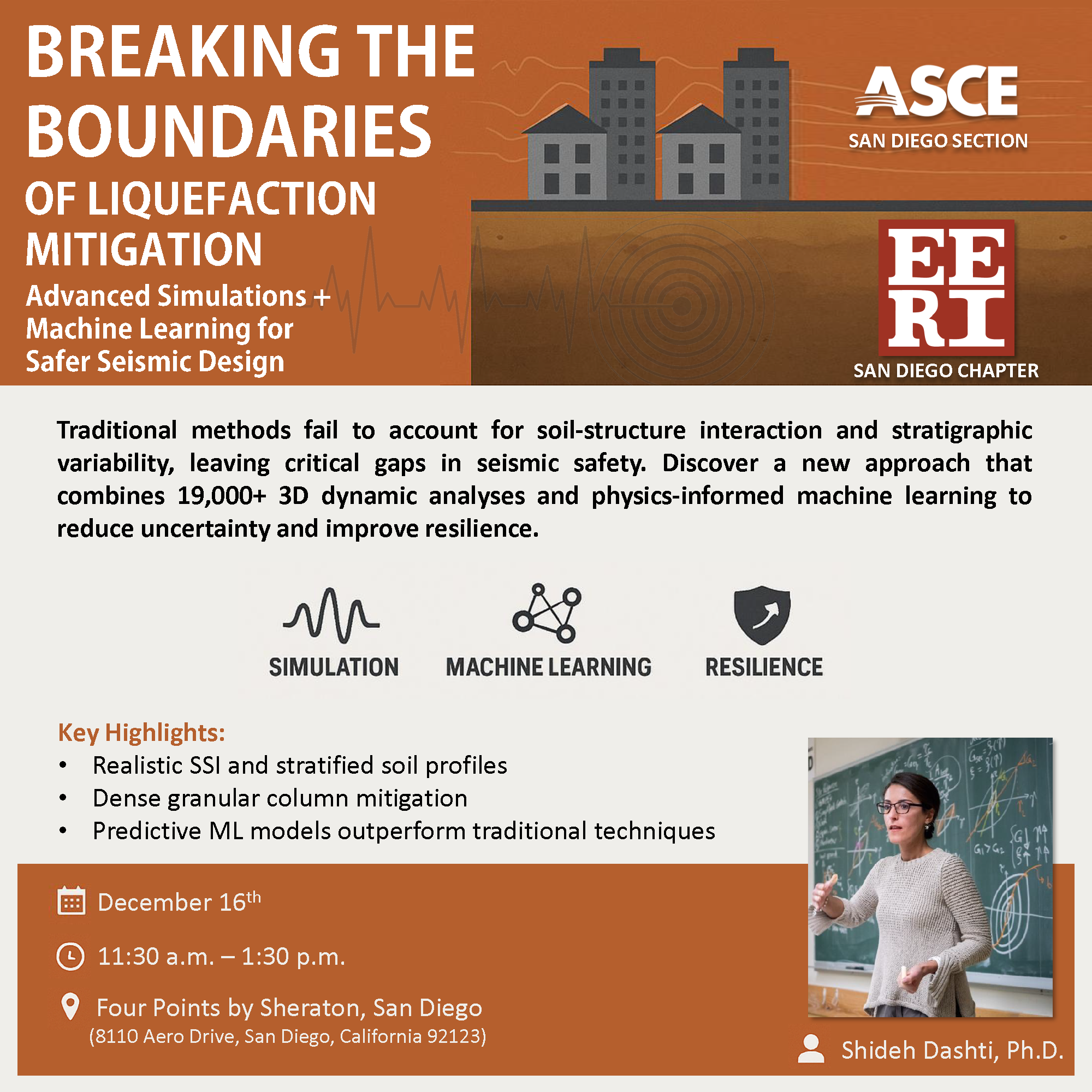
11:30am-1:03pm
Four Points by Sheraton, San Diego
8110 Aero Drive
San Diego, CA 92123
ASCE San Diego Section is co-hosting their December Lunch Program with EERI, featuring guest speaker Dr. Shideh Dashti, 2025 EERI Distinguished Lecturer. Please join us at Four Points Sheraton to hear about a novel method incorporating simulation and machine learning to improve seismic resilience.
For members of EERI or ASCE = $60
For non-members = $90
For public agency or student members of EERI or ASCE = $40
Click the image on the right to view the event flyer.
REGISTRATION
Click here to register for the luncheon.
Abstract: The existing engineering methodologies for mitigation of seismic liquefaction rely on free-field triggering in uniformly layered granular soil deposits. These methods do not evaluate performance, and they routinely ignore cross-layer interactions in realistically stratified deposits as well as soil-structure interaction (SSI). In this presentation, through an experimental-numerical-statistical study, we show that these methods are unreliable, jeopardizing our ability to assess and mitigate liquefaction vulnerability of our sites and structures. We performed more than 19,000 and 4,000 fully-coupled, 3D, dynamic finite element analyses of free-field site response and seismic SSI, respectively, in OpenSees. These simulations were calibrated and validated with element and centrifuge experiments. The datasets were designed using quasi-Monte Carlo sampling, to capture a wide range of critical parameters, including stratigraphic variability, soil types and properties, foundation and structure properties, mitigation mechanisms and geometry using dense granular columns (DGCs), and ground motion characteristics. The influence of stratigraphic variability on mitigation efficacy is shown to be significant in terms of foundation settlement, tilt, spectral accelerations, and flexural drift. Physics-informed, random forest, machine learning (ML) is subsequently used to identify the key predictors and models for free-field ejecta potential in highly nonlinear and stratified soil profiles, as well as mitigated/non-mitigated ratios of foundation’s vertical and lateral displacement and foundation and roof peak accelerations. The models show strong predictive performance on independent test sets, significantly reducing uncertainty and outperforming traditional regression techniques. Combining advanced numerical simulations and machine learning enables a new approach to liquefaction mitigation, one that accounts for seismic soil-structure interaction in realistic sites and structures.
Bio: Shideh Dashti is a Professor in Geotechnical Engineering and Geomechanics at the University of Colorado Boulder (CU) and the Associate Chair for Administration in the Department of Civil, Environmental and Architectural Engineering. She also directs a college-funded interdisciplinary research theme titled RISE: Resilient Infrastructure with Sustainability and Equity. Shideh obtained her undergraduate degree at Cornell University in 2004 and graduate degrees at the University of California, Berkeley in 2009. She worked briefly with ARUP and Bechtel on several engineering projects in the U.S. and around the world, spanning seismic design of underground structures, foundations, and slopes. Her research team at CU studies: the interactions and interdependencies among infrastructure systems during earthquakes and climatic extremes; seismic performance of underground structures; triggering, consequence, and mitigation of the liquefaction hazard at local and regional scales; impact of compound climatic-seismic hazards on geotechnical infrastructure; and the intersection of resilience, environmental sustainability, and justice. She is the recipient of the 2018 Arthur Casagrande Award and the 2021 Walter Huber Civil Engineering Research Prize from ASCE as well as the 2025 Distinguished Lecture Award from EERI, among other recognitions.